
Moodboard vs Visual Reference Library: Which One Do You Need?
Compare moodboards and visual reference libraries by purpose, lifespan, structure, and the design decisions each one supports.
Direct answer
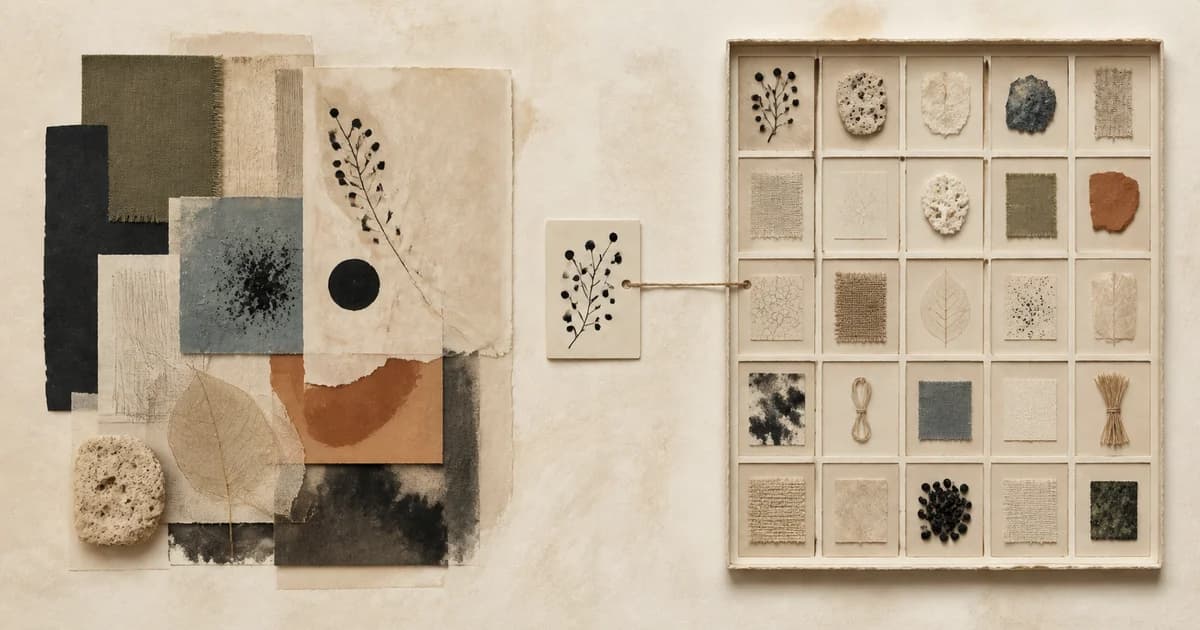
Use a moodboard to align people around the direction of one project. Use a visual reference library to preserve sourced examples and reasoning across many projects. Most design practices benefit from both: retrieve evidence from the library, then edit a small selection into a moodboard with a clear point of view.
The difference is the job, not the canvas
A moodboard is an edited argument. It assembles images, color, type, material, language, and sometimes motion to establish the intended feeling or visual direction of a specific piece of work. Milanote’s description emphasizes a flexible visual arrangement that can include notes, videos, links, and feedback, which reflects the board’s communication role.[1]
A reference library is an evidence store. Its material may be less harmonious because it serves several future questions. Search, metadata, folders, tags, and filters matter more than composition. Asset and bookmark tools such as Eagle and Raindrop focus on those retrieval mechanics.[2][3]
- Moodboard: one project, one directional argument, small edited set.
- Reference library: many projects, many questions, cumulative sourced set.
- Shared need: attribution, rationale, and an owner who removes weak material.
Choose the artifact that resolves the current uncertainty
If a team is debating whether a product should feel clinical or tactile, make a moodboard. If the team cannot remember which onboarding examples handled permissions well, search or build a reference library. If both problems exist, retrieve from the library and place only the strongest evidence on the board.
Do not turn the moodboard into a warehouse. Once every saved image is included, its hierarchy disappears. Likewise, do not expect a library to create alignment by itself. A search result is material for a decision, not the decision.
A simple handoff between library and board
Begin with the project question. Retrieve ten possible references, then remove any that do not support a distinct principle. Group the remainder by the decision they inform, not by color alone. Add a short caption to each group and record what the team will do—and what it will avoid—as a result.
After the project, return the most reusable examples and the decision note to the library. The board can remain a historical record, but the library receives only the evidence likely to earn another retrieval. This prevents every project artifact from becoming permanent clutter.
Questions designers ask
Can a moodboard be a reference library?
A board can hold references, but it becomes a library only when it is maintained for retrieval and reuse beyond the current project.
Which should a beginner make first?
Make the artifact that serves the next decision. Start with a moodboard for one live project; begin a library when useful references repeatedly go missing between projects.
Sources checked
- The perfect moodboard — Milanote
- Eagle reference image library — Eagle
- Raindrop.io bookmark manager — Raindrop.io